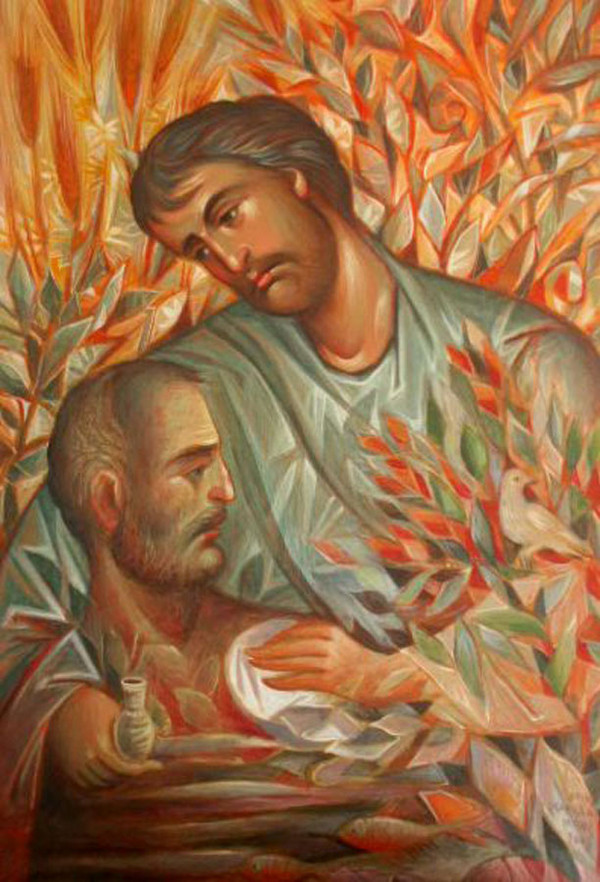
Sunday, July 10, 2022

5 Pentecost


Good Samaritan Sunday


July 10, 2022


Luke 10.25-37


+ For those of you who listen or read my sermons week in and week out, you know that my “themes” are pretty basic and consistent.


Yes, there might be variations on those “themes,” but, in their core, there is really only one main “theme” to everything I preach.


Love God. Love others. That’s pretty much it.


Which is why our Gospel reading this morning is an important reading.


No, I’m not being emphatic enough.


It’s not just an important reading.


It is, in my opinion, the single most important reading for us as Christians.


And, for those of you who have known for me for any period, you know how I feel about what is being said in today’s Gospel.


For me, this is IT.


This is the heart of our Christian faith.


This is where the “rubber meets the road.”


When anyone has asked me, “What does it mean to be a Christian?” it is this scripture I direct them to.


When anyone asks me, must I do this or that to be “saved,” I direct them to this reading.


This is what it is all about.


So, why do I feel this way?


Well, let’s take a look this all-important reading.


We have two things going on.


First, we have this young lawyer.


He comes, in all earnestness, to seek from Jesus THE answer.


“What must I do to inherit eternal life?”


What must I do to be saved?


This, after all, is the question we are ALL asking, isn’t it?


And, guess what?


He—and all of us too—gets an answer.


But, as always, Jesus flips it all around and gives it all a spin.


Jesus answers a question with a question.


He asks the lawyer, “what does the law say?”


The answer is a simple one.


And, in Jewish tradition, it is called the Shema.


The Shema is heart of Jewish faith.


It is so important that it is prayed twice a day, once in the morning, once at night.


Jesus himself would have prayed the Shema each morning upon awakening and again before he went to sleep at night.


It is important, because it is the heart of all faith in God.


So, what is the answer?


The answer is, “You shall love the Lord your God with all your heart, , and with all


your soul, and with all your strength, and with all your mind;”


And additionally, “and [love] your neighbor as yourself.”


Then, Jesus says this:


“do this, and you will live.”


I repeat it.


Do this—Love God, love your neighbor—and you will live.


This is what we must do to be saved.


Now that sounds easy.


But Jesus then complicates it all with a parable.


And it’s a great story.


Everyone likes this story of the Good Samaritan.


We even commemorated it in our very first stained glass window.


After all, what isn’t there to like in this story?


Well…actually…in Jesus’ day, there were people who would not have liked this story.  


In Jesus’s day, this story would have been RADICAL.


The part of this story that most of us miss is the fact that when Jesus told this parable to his audience, he did so with a particular scheme in mind.


The term “Good Samaritan” would have been an oxymoron for those Jews listening to Jesus that day.


Samaritans were, in fact,  quite hated.


They were viewed as heretics, as defilers, as unclean.


They were seen as betrayers of the Jewish faith.


So, when Jesus tells this tale of a Good Samaritan, it no doubt rankled a few nerves in the midst of that company.


With this in mind, we do need to ask ourselves some very hard questions.

Hard questions we did not think we would be asked on this Good Samaritan Sunday.   

You, of course, know where I am going with this.

So, here goes:

Who are the Samaritans in our understanding of this story?

For us, the story only really hits home when we replace that term “Samaritan” with the name of someone we don’t like at all.

Just think about who it is in your life, in your political understanding, in your own orbit of people who you absolutely despise.

Think of that person or persons or movements that simply makes you writhe with anger.

Those are your Samaritans!

It’s not hard to find the names.

Now, try to put the word “good” in front of those names.

It’s hard for a good many of us to find anything “good” in any of these people.  

For us, to face the fact that these people we see as morally or inherently evil could be “good.”

We—good socially-conscious Christians that we are—are also guilty sometimes of being complacent.  

We too find ourselves sometimes feeling quite smug about our “advanced” or “educated” ways of thinking about society and God and the Church.  

And we too demonize those we don’t agree with sometimes.

I, for one, am very guilty of this

It is easy for me to imagine God living in me personally, despite all the shortcomings and negative things I know about myself.


I know that, sometimes, I am a despicable person and yet, I know that God is alive in me, and that God loves me.


So, why is it so hard for me to see that God is present even in those whom I dislike, despite those things that make them so dislikeable to me?


For me, this is the hard part.


The Gospel story today shows us that we must love and serve and see God alive in even those whom we demonize—even if those same people demonize us as well.


Being a follower of Jesus means loving even those we, under any other circumstance, simply can’t stand.


And this story is all about being jarred out of our complacent way of seeing things.

It’s also easy for some of us to immediately identify ourselves with the Good Samaritan.


We, of course, would help someone stranded on the road, even when it means making ourselves vulnerable to the robbers who might be lurking nearby.  


Right?


But I can tell you that as I hear and read this parable, I—quite uncomfortably—find myself sometimes identifying with the priest and the Levite.


I am the one, as much as I hate to admit it, who could very easily, out of fear or because of the social structure in which I live, find myself crossing over to the other side of the road and avoiding this person.


And I hate the fact that my thoughts even go there.


See, this parable of Jesus is challenging and difficult.


But…


Something changes this whole story.


Something disrupts this story completely.


Love changes this whole story.


When we truly live out that commandment of Jesus to us that we must love God and love our neighbor as ourselves, we know full-well that those social and political and personal boundaries fall to the ground.


Love always defeats our dislike of someone.


Love always defeats the political boundaries that divide us.


Love always softens our hearts and our stubborn wills and allows us see the goodness and love that exists in others, even when doing so is uncomfortable and painful for us.

Now I say that hoping I don’t come across as naïve.


I know that my love of the racist will not necessarily change the racist.


I know that loving the homophobe will not necessarily change the homophone.


I know that loving the Nazi and the Fascist are definitely not going to change the Nazi and the Fascist.


Trust me, I know that loving certain politicians (whose names I will not mention) is not going to change those politicians!


But you know what?


It does change me.  


It does cause me to look—as much as I hate to do so—into the eyes of that person and see something more.  


It does cause me to look at the person and realize that God does love this person despite their failings and their faults—just as God loves me despite my failings and my faults.

These are the boundaries Jesus came to break down in us.  


And these are the boundaries Jesus commands us to break down within ourselves.


“What must I do to inherit eternal life?” the lawyer asks Jesus.


And what’s the answer?


Love is the answer.  


We must love—fully and completely.

“Do this,” Jesus says, “and you will live.”


It not only about our personal relationship with Jesus.


It not about accepting Jesus as our “personal Lord and Savior.”


That’s not what saves us.


He nowhere says that is what will save us.


What will save us?


Love will save us.


Love of God.


Love of one another.


Loving ourselves.


Loving what God loves.


Love will save us.


Love will liberate us.


Love will free us.  


Jesus doesn’t get much clearer than that.


Because let’s face it.


We are the Samaritan in this story.


We are—each of us—probably despised by someone in our lives.


We, to someone, represent everything they hate.


The fact is, God is not expecting us to be perfect.


God worked through the Samaritan—the person who represented so much of what everyone who was hearing that story represents as wrong.


If God can work through him, let me tell God can work through you and me.


We do not have to be perfect.


Trust me, we’re not perfect.


And we will never be perfect.


But even despite this, God’s light and love can show through us.


So let us reflect God’s love and light.


Let us live out the Shema of God—this commandment of God to love—in all aspects of our lives.


Let us love.


Let us love fully and radically and completely.


Let us love God.  


Let us love each other.


Let us love ourselves.


Let us love all that God loves.


Let us love our neighbor.


Who is our neighbor?  


Our neighbor is not just the one who is easy to love.


Our neighbor is also the one who is hardest to love.


Love them—God, our neighbor—and yes, even ourselves.


And you and I--we too will live, as Jesus says.


And we will live a life full of the light we have reflected in our own lives. 


And that light that will never be taken from us. 


Sunday, July 3, 2022

4 Pentecost


July 3, 2022


Luke 10.1-11, 16-20


+ This past Thursday I did a wedding on LaSalle Lake near Itasca.


Deacon John assisted at the wedding, since he was close friends with the bride.


I also decided to take a few days for myself, so I stayed in the area for a while.


And, like many of you, when I drive, I think.


I think a lot.


I found myself thinking about the fact that, for most of my entire career as a priest, I have always felt like an outsider.


Outside the norm in the larger Church.


This past week on a Facebook friend of mine posted that it was his anniversary of ordination to he priesthood.


And he began his post in a wonderful way.


He wrote: “I give grateful thanksgiving for The Right Reverend So-and-So who ordained my to the Priesthood on this day in 1989.”


I loved that.


But I was also saddened by that.


Because, I realized, I would never be able to write that.


The Bishop who ordained me blocked me recently on Facebook.


I’m not even making that up.


It seems my entire ministry, for the most part, has been a ministry under rebellion of some sort.


And not a conscious rebellion.


I really have wanted just to be normal, to get through, to have just a nice, ministry without ruffling feathers.


But sometimes, there are just people who by their very presence ruffle feathers.


I am one of those people, I guess.


And for a long time I really hated that.


I fought it.


I tried hard to just be a normal priest doing a normal ministry just like my normal colleagues.


But even then, some innocent comment of mine was taken out of context and I was in hot water with a Dean or a Bishop or a fellow priest.


And my wrists would be slapped, or my sermons were corrected or being denied promotions in the Church.


Now, I’m not saying I’m sweet and innocent.


Not by any sense of the word.


I have a big mouth.


And I speak out.


Let’s face it, I don’t put my flame under a bushel.


I guess that’s threatening some people.


I say things I later regret.


But the level of ostracization I have often felt in the Church is deep, much deeper than a priest with a smart mouth deserves at times.


I have been THAT priest for so long—that rebel priest, that upstart priest, that priest who swam consistently against the stream--that lone wolf priest--that I don’t know how to be a different priest.


I’ll confess—and I am somewhat ashamed to do so—but I have gotten used to being the lone wolf.


I’ve developed some thick, thick skin in my career.


But still, sometimes, the barbs cut deeper than any thick skin.


And sometimes even lone wolf priests bleed.


But even then, he can still howl!


Now, I’m not romanticizing lone wolf ministry by any means.


Lone wolf ministry can be very dangerous behavior.


We really shouldn’t do ministry and be a lone wolf.


Doing ministry means doing it together.


And I know: by saying just that I am sounding kinda like a hypocrite here.


For any of you who know me and worked with me for any period of time, you know I’ve just done lone wolf behavior about many things.


Some may call it lone wolf.


I guess I always called it being independent.  


Or maybe, sometimes, just impatient.


Things have to get done after all.


And, when they do, you know, I’ll just do it.


But, being a lone wolf is not a good thing.


In the Church it is never a good thing to be a lone wolf.


None of us can do ministry alone.


We all need to admit that we need each other to do effective ministry.


And sometimes even the lone wolf admits that simple fact: I can’t do this alone.


The lone wolf sometimes has to seek help from others.


Ultimately, the lone wolf can be a bad thing for the church for another reason though.


Lone wolves can easily be led down that ugly, slippery slope of believing, at some point, that  it’s all about them.


Now, I want to make clear: I never have believed that anything is about just me.


I despise that kind of thinking in myself.


I have never felt that way.


For all my lone wolf tendencies, I have a pretty good support system around me—people who will very quickly tell me when they think I might be heading down that slippery egocentric slope.


And when they don’t, God does.


I’m regularly put in my place.


There is, after all, a difference, I have discovered between “lone wolf” behavior and ego-centric, it’s-all-about-me, I-don’t-need-anyone’s-help behavior.


And as you all know, I have no problem asking your advice and your opinions on anything before some of the things I’ve done as the Rector of St. Stephen’s.


I might not necessarily heed those suggestions.


But I appreciate them, and they are, for the most part, helpful.


But, I have known too many church leaders who have not had a support system like mine.


I have known too many church leaders who have  made it clear to me that it was because of them—because their winning personality, or their knowledge of church growth, or their years of expertise—that a particular parish or diocese flourished.


It’s an unfortunate trap leaders in the Church fall into when they believe that a congregation’s success depends on them as individuals and their own abilities of ministry—and, mind you, I am not just talking about priests here. Lay leaders in the Church have fallen into this trap as well. I have known some of those lay leaders as well, trust me.  

Maybe to some extent it’s true.


Maybe some people do have the personality and the winning combination in themselves to do it.  


But for those who may have that kind of natural personality, I still have to admit: it all  makes me wary.


It’s just too slippery of a slope.


We are dealing with similar personalities in today’s Gospel.


In our Gospel reading for today, those seventy that Jesus chose and sent out come back amazed by the gift of blessing God had granted to them and their personalities.


They exclaim, “Lord, in your name even the demons submit to us!”


In and of its self, that’s certainly not a bad thing to say.


It’s a simple expression of amazement.   


But Jesus—in that way that Jesus does—puts them very quickly in their place.  


He tells them, “do not rejoice in these gifts, but rejoice rather that your names are written in heaven.”


Or to be more blunt, he is saying rejoice not in yourselves and the things you can do with God’s help, but rejoice rather in God.


The burden of bringing about the Kingdom of God shouldn’t be solely the individual responsibly of any one of us.  


Even Jesus made that clear for himself.


Just imagine that stress in having to bring that about.  


Bringing the Kingdom of God into our midst is the responsibility of all of us together.  


It is the responsibility of those who have the personality to bring people on board and it is the responsibility of those of us who do not have that winning personality.

For those of us who do not have that kind of personality, it is our responsibility to bring the Kingdom about in our own ways.


We do so simply by living out our Christian commitment.


As baptized followers of Jesus, we bring the Kingdom into our midst simply:


By Love.


We do it by loving God and loving each other as God loves us in whatever ways we can in our lives.


 Bringing the Kingdom of God about in our midst involves more than just preaching from a pulpit or attending church on Sunday.


Spreading the Kingdom of God is more than just preaching on street corners or knocking on the doors. 


It means living it out in our actions as well.


It means living out our faith in our every day life.


It means loving God and each other as completely and fully as we can.


But it does not mean loving ourselves to the exclusion of everything else.


It means using whatever gifts we have received from God to bring the Kingdom a bit closer.  


These gifts—of our personality, of our vision of the world around us, of our convictions and beliefs on certain issues—are what we can use.


It means not letting our personalities—no matter how magnetic and appealing they might be—to get in the way of following Jesus.


Our eyes need to be on God.


We can’t be doing that when we’re busy preening in the mirror, praising ourselves for all God does to us and through us.   


The Church does not exist for own our personal use.  


I, for example, am not your free therapist.


And the Church is not you group therapy.


If we think the Church is there so we can get some nice little pat on the back for all  the good we’re doing, or as an easy way to get us into heaven when we die, then we’re in the wrong place.


And we’re doing good for the wrong intention.


The Church is ideally the conduit through which the Kingdom of God comes into our midst.


And it will come into our midst, with or without me as individual.


But it will come into our midst through us.


All of us.


Together.  


The Church is our way of coming alongside Jesus in his ministry to the world.


In a very real sense, the Church is our way to be the hands, the feet, the voice, the compassion, the love of God to this world and to each other.


But it’s all of us.


Not just me.


Not just you as an individual.


It’s all of us.


Together.


Working together.


Loving together.


Serving together.


And giving God the ultimate credit again and again.


Hopefully, in doing that, we do receive some consolation ourselves.  


Hopefully in doing that, we in turn receive the compassion and love of God in our own lives as well.


But if we are here purely for our own well-being and not for the well-being of others, than it is does become only about us and not about God.  


And in those moments, we are sounding very much like those 70 who come back to Jesus exclaiming, “look at what we have done!”

The message of today’s Gospel is that it must always be about God.


It must always be about helping that Kingdom of God break through into this selfish world of huge egos. It means realizing that when we are not doing it for God, we have lost track of what we’re doing. We have lost sight of who we are following.


So, let us—together—be the hands, the feet, the voice, the compassion and the love of God in the world around us. Like those 70, let us be amazed at what we can do in Jesus’ name.


But more importantly let us rejoice!


Rejoice!


Rejoice this morning!


Rejoice in the fact that your name, that my name—that our names are written at this moment in heaven.


Let us pray.


Holy and loving God, we thank you this morning. We rejoice in the fact that in this moment our names, known to you, are written in heaven, and that we are headed toward the goal you set. Keep us on the right path, following Jesus where we must go and doing what we must do; We ask this in Jesus’ Name. Amen.  


19 Pentecost/St Francis of Assisi

  October 4, 2026   + Today, of course is the feast of St. Francis of Assisi, one of the most beloved and revered saints in the Church. ...