Sunday, September 17, 2023

16 Pentecost


September 17, 2023


Matthew 18.21-35

 + I am going to ask you a question this morning.

 Do you have any “frienemies?”

 I’m not saying murderers or criminals or Nazis.

 I mean, do you have people who aren't quite friends but also not quite enemies?

 I think we all do.

 I know I do.

 And, I have to admit, sometimes they drive me crazy.

  I want to like them.

 But sometimes, it’s really hard.

 And sometimes—sometimes!—I just don’t want to have anything to do with them.

 I want to distance myself from them and be done with them.

 Those people who claim to be friends, but who hurt us, sometimes do so unintentionally.

 Sometimes I seem to have an inordinate amount of them in my life at times.

 So, of course, those are the people who come to mind when I read our Gospel reading for today.

 It is not my “enemies” I think of when I hear the Gospel.

 It’s my “bad” friends or “frienemies.”

 In our Gospel reading, we find Jesus challenging us on this issue.

 He is telling us, once again, maybe something we don’t want to hear.

 Today we find Jesus laying it very clearly on the line.

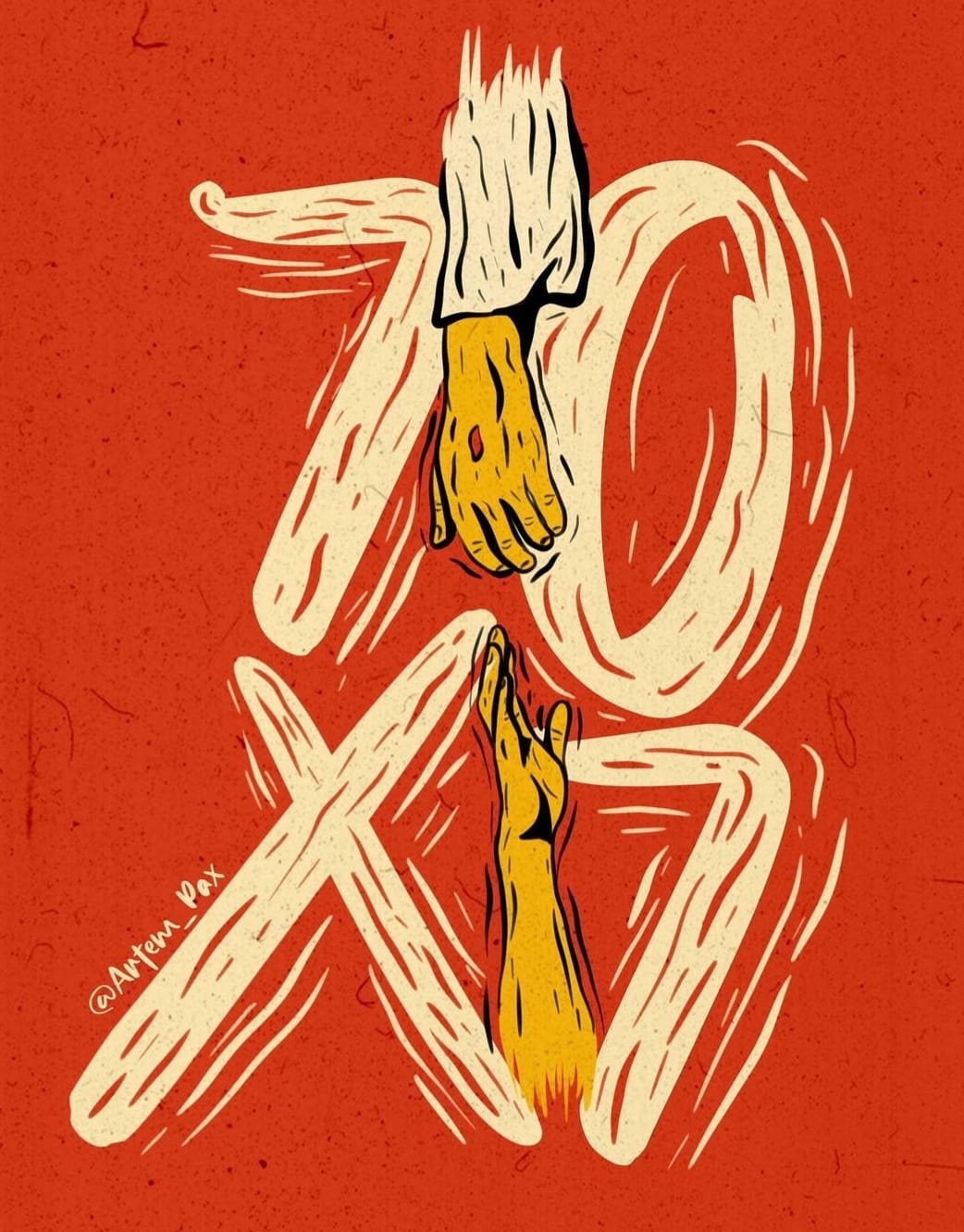
Peter has asked how many times he should forgive. “Seven times?” he wonders.

But Jesus says,

“Not seven times, but, I tell you, seventy-seven times.”

In other words, we must forgive those who wrong us, again and again.

Oh, yeah, he also says that if we don’t forgive the sins of others, our own sins won’t be forgiven.

I’ll get into that in a minute.

But back to this whole forgiving seventy-seven times:

It has taken me a long time to learn the power of this radical kind of forgiveness.

 And it has not been easy for me!

 But, the problem here is that, as hard it is for me with my bad friends and with this radical forgiveness, I have to remember something very important.

 I have been, at times, a bad friend to someone.

 I have been a “frienemy.”

 Probably to too many people.

 I am the person who sometimes has caused issues.

 I am the person that has caused those people distance themselves from me in turn.

 And I have to own that.

 I have to face the fact that what I do matters to others and to God.

 Being a jerk to people has consequences.

 And, I realize, on top of all that, I still retain the wrongs that I felt had been done to me and I cannot  sometimes get around what had been done to me.

 I harbor sometimes real anger at people—and not righteous anger, you know, like toward Nazis.

 Petty, selfish anger.

 And all this causes me to be in a state of almost constant war and conflict with those people, whether they are aware of it or not (most of them are not).

 I am not proud to admit any of this—to myself or to anyone else.

 But, I am a fallible human being, like everyone else here this morning.

All this led me to another sobering thought.

A few weeks ago I preached about being a life-long pacifist.

Being a pacifist is something I am very proud of in my life. 

My pacifism, at least at this point in my life, is anchored squarely in our Baptismal Covenant in which we promise, with God’s help, to “strive for justice and peace among all people.”

I have tried very hard to live that out in my life—all my life.

I have been very quick to speak out and protest wars and invasions.

I have no problem standing up and saying “no” to wars that happen “over there.”

But to be a true pacifist, to be a true seeker after peace, we all must cultivate peace in our midst.

When we say that we will “strive for justice and peace among all people,” that means us individually as well.

We must be peaceful in what we do and say.

And peace begins with respect for others.

Peace begins with responding to God’s commandment to love others as we love ourselves.

Which bring sus to that whole thing Jesus about our own sins not being forgiven if we don’t forgive others “from the heart.”

What’s going on with that?

Is Jesus telling us that God doesn’t forgive us?

I thought God loved us.

Well, what I think Jesus is really getting at is that our relationship with God is hindered if we have barriers in that relationship.

And one of the barriers in our relationship with God is us carrying around anger and frustration and a refusal to forgive others.

 And when we do that, when we carry around our anger, our refusal to forgive, we are at war.

Now, you might say “war” is a strong word here.

But let me tell you, it sure ain’t peace!

I hate to admit it, but I am often at war with myself.

And that war often either stems from or overflows into my relationships and the world around me.

If we are truly going to be seekers after peace, we must start by making peace with ourselves.

We must actually forgive—in some way—those who have wronged us.

If not, we lose.

Not the person we’re mad at.

More often than not, they could care less that we’re mad at them.

They’re not losing sleep over the wrongs they’ve done to us.

They’re not feeling guilt over it.

And that drives us crazier than anything!

So, we are the ones in turmoil over what they have done to us.

We can’t make anyone feel anything.

And we can’t make anyone apologize to us or make right the wrongs they have doen to us.

We can’t control others.

But we can control ourselves and how we respond to what others do to us.

I use a phrase often: when someone wrongs us and we refuse to forgive, we are just letting them live rent-free in our heads.

We are allowing them to live there.

And trust me they do.

And when someone wrongs us and we carry around all that pain and suffering, we are the ones who suffer.

Deeply.

How are we going to have any meaningful, loving relationship with God or others, or ourselves, when we are carrying all of these terrible, negative things within us?

We can’t.

We must forgive.

Even when it hurts.

Even when we really don’t want to.

Even when doing so is an admission of defeat.

But, it isn’t defeat.

It’s ultimate victory.

I forgive, and by doing so, I evict those people from residing in my mind.

It doesn’t undo the wrongs.

It doesn’t even make everything right all the time.

But it does allow me to say I have no hindrance between them and God and myself.

So, you might be saying, I get it, Father Jamie.

I can do that.

But. . .

That’s not all.

It’s not only about forgiving others.

It’s also about forgiving one very important person in our lives—probably the most important in our lives—outside of God of course.

Our selves.

We must also learn to forgive ourselves seventy times seven.

We must learn to forgive ourselves too.

Because let me tell you, not forgiving ourselves also is a hindrance in our relationship with God and others.

Seeing ourselves as God’s own beloved in this world is often the hardest thing of all.

We tend to hate ourselves, or despise ourselves more than we hate or despise others.

So, we must strive for justice and peace among all people, even ourselves.

We must respect the dignity of every human being, even our own being.

How do we do that?

Well, as followers of Jesus we must actually grant forgiveness to those who have wronged us in whatever way.

That is what all of us, as baptized Christians, are called to do.

In a practical way, we can just simply their name and say, “So and so, child of God, beloved of God, I forgive you.”

And mean it.

Deeply.

And when we do, we are truly freed.

Sometimes, if we are fortunate, we may be able to forgive some of these people to their face.

More often than not, we never get that chance.

On very rare occasions, those people will come to us in repentance asking for forgiveness.

But more often than not, they will never ask for our forgiveness.

And they probably will not change their behavior.

Which brings me to one side note:

Forgiveness does not equal taking abuse from others.

We can forgive what people have done, but we are not called to just go back to old ways of abuse.

If someone has abused us physically or emotionally or psychologically, we must protect ourselves and not allow that behavior to continue.

But we can still forgive even those people.

Forgiving does not mean forgetting.

But forgiving does mean that when we forgive them—they are forgiven.

It is just that powerful!

When we forgive, those wrongs done against us are forgiven.

What we loose on earth—what we let go of, what we forgive on earth—is truly loosed in heaven.

And when we realize that, we then must move on.

We must allow true peace—that peace that we, as baptized Christians, strive for—we must allow that peace to settle into our hearts and uproot any lingering anger or frustration that still exists there.

We must allow that peace to finish the job of forgiveness.

This is what it means to forgive.

This is what it means to forgive again and again—even seventy-seven times, or a hundred and seventy-seven times, or seven hundred and seventy-seven times.

And, I stress, we must forgive ourselves too!

We sometimes have to forgive ourselves of the wrongs we have committed against ourselves and others.

When I talked earlier about allowing the anger and the pettiness in my life to control my life, in those moments, I was wronging my own self.

I failed myself in those moments.

And often, when we fail ourselves, we wallow in that failure.

We beat ourselves up.

We torture ourselves unduly.

Let me tell you, I have done it on many occasions.

But in those moments, there is no peace in my heart either.

I am allowing the war against myself to rage unabated within me.

Only when we are able to finally forgive ourselves, will we be able to allow true peace to come into our lives.

And while I have forgiven others many times, the only one I have ever had to forgive seventy times and much, much more is myself.

And again, it is as easy as saying to myself, “Jamie, child of God, loved by God, I forgive you” and to allow that absolution to do its job of absolving—of taking away the wrongs I have done.

So, let us forgive.

Let us forgive others.

Let us forgive ourselves.

And in doing so, let us let God’s peace settle into our hearts and our lives.

And let that peace transform us—once and always—into the person God truly desires us to be.

Sunday, September 10, 2023

Dedication Sunday


September 10, 2023


Genesis 28.10-17; 1 Peter 2.1-5,9-11


+ I love our Dedication Sundays.


I really do!!


It is this one Sunday each year when we really get to celebrate St. Stephen’s and all it is and does.


We get to celebrate what it has been, what it is and what it will be.


And we get to celebrate all that God does for us here.


On our website, we are described as a


“growing, inclusive community of artists, poets, musicians, professionals, writers, students and searchers for God.”


I love that description of us.


Because that is who we are.


If you have not looked at our website, or any of our many social media, please do!


But St. Stephen’s is, to say the very least, a unique place. 

There are not many congregations quite like it—this weird and wonderful blend of peace and social justice-based ministry blended with a moderate High Church form of worship and spirituality.

This is not some nonsensical mish-mash, however.

This is a place wherein somehow it all comes together and forms a good solid base.

 It is for this reason so many people are drawn to this out-of-the-way church in the far reaches of Northeast Fargo.

I had one parishioner say to me that St. Stephen’s is a really a kind of spiritual powerhouse.

This wonderful, eclectic place which has become home to so many people.

 Some people—especially those of who attend here week-in and week-out, might not see this as all that unique of place.

Sometimes we don’t see the treasures right under our noses, because they’re just that close.  

But let me tell you, others definitely think we’re unique.


Andrew Urano, who has been attending here for the last several months, definitely think we’re unique.


He’s attended over 200 Episcopal churches all over the country.


And he definitely came here expecting one thing and found something completely different.


He came here expecting to find 1979 BCP and Hymnal 1982 hymns (all of which he loves).


He found liturgies adapted from Enriching Our Worship inclusive language Eucharists, Celtic Masses and New Zealand Prayer Book.


This past week, Jane Gaffrey sent me a note about how important St. Stephen’s has been not only to her but to her son Jason, who is trans:


Jane wrote me this this week:


“I hear from Jason how much he is awed and happy because of you and others at St Stephens --how much he feels accepted and loved as he is.  And everyday I hear how awed he is that you share your own humanity and struggles publically.  He loves how REAL people are and how you and the church love others well no matter who they are.”


Andrea Olsen, who was featured in an article on Episcopal News Service which has garnered A LOT  of attention, shares how she never felt welcome anywhere like she was welcomed here, and she had attended quite a few churches in her search.


Even Mother Mary Johnson, a retired priest in this Diocese, who has filled in for me a few times over the years when I’ve been on vacation, this past week was accidentally contacted when we were updating our directory.


Her number got mixed up with our parishioner Mary Johnson’s phone number.

She sent me a text message afterward saying,


“I would GALDLY be claimed as part of the St. Stephen’s community!”


Mother Mary, by the way, was one of the few people in this diocese how actually reached out and commended us for our standing on DEPO back in 2015


We have parishioners who did not feel welcome in any other church either here in Fargo or in any of the other places they have lived.


But they felt welcomed—and more than that—included—here.


I hate to break this news to you, but this kind of radical hospitality is NOT common in the Church—even among so very many Episcopal churches.


If you look at our social media you will see what people are saying there about us.


And the renovations we have made here have been a symbol in many ways of what we are truly doing here.


These renovations are important for us to reflect the vitality and the beauty of our parish.


Remember what it looked like in our nave back in 2007, for those of you who were here?


It was plain.


As in Quaker Meeting House plain.


Steve Bolduc shares the joke that one time there was a Diocesan gathering here at St. Stephen’s about 20 years ago.


Two people in line for food in the Undercroft were overheard by Steve saying, “Ah, St. Stephen’s! So low church it should be called Mr. Stephens.”


I love that story!


I love it, because that aint us now!


As we slowly brought more beauty into our physical building, not everyone was happy about those changes.


And that’s normal.


Some people felt it too “busy” in the church.


Some people feared stained glass windows for fear that it was would darken the church.


People feared a memorial garden because they didn’t want to see a cemetery on the church property.


People feared a bell because it might irritate the neighbors.


But a few weeks ago, Greta Taylor, who has been attending St. Stephen’s since the late 1950s pulled me aside and told me how she loved the fact the door to sacristy was moved.


It looked like how it was when she first started attending here.


And that all the attention when one enters is directed to exactly where it should be—on the altar, and on the beautiful cross above the altar, that has come to truly symbolize our community here.


This renovation has been a much-needed boost.


And I know our Altar Guild rejoices in it.


But we are more than our windows, our altar, our cross, our bell, our tower, our organ, our labyrinth, our memorial garden, our renovated sacristy.


We are so much more than these four walls and this roof.


This building symbolizes and reflects who and what we are—a parish based on Peace and Social Justice with a healthy dose of High Church worship and spirituality in our following of Jesus in this world.


But even that doesn’t fully represent who we are.


This past Wednesday night I preached about Paul Jones, who is commemorated in our Peace and Social Justice window,  and, more specifically, about the book Outlaw Christian by my friend Jacqueline Bussie.


If you have not read this book, READ THIS BOOK!


Jacqueline Bussie and her late husband Matt Myer attended briefly this church.


She saw in us an outlaw Christian community.


Outlaw Christians are people are not afraid to rant, and speak out, and rail at the realities we are faced with.


Outlaw Christians don’t sugarcoat it.


Holy, righteous ranting and speaking out and not conforming to the status quo is very much a part of our peace and social justice tradition, as well as our High Church bent.


You don’t believe me?


Look at these windows!


These windows are rants!


These windows are our sermons.


Our whole, 67 year ministry here at St. Stephen’s is a rant—a long, impassioned, often angry speech.


And yes, I did say angry.


Anger isn’t always a bad thing.


We need to be angry about some things.


And I am angry.


I am angry when we are told to put our flames under bushels.


I am angry when I am told that we should be comply, that we should simply go with the flow.


Holy, righteous anger is not a bad thing.


And many of us are here because we are angry at the way the Church has treated us in the past.


On this Dedication Sunday, I very proudly boast of all that God has done here.


And if my boasting may at times sound like a rant at times, I make no apologies for that.


I have no qualms about boasting about what all of us are doing here at St. Stephen’s.


In our wonderful reading this morning from St. Peter, we find him saying,


“Once you were not a people,

but now you are God’s people;

once you had not received mercy,

but now you have received mercy.”


When we look around us this morning, as we celebrate 67 years of this unique, spiritual powerhouse of a congregation, we realize that truly we are on the receiving end of a good amount of mercy.


We realize that mercy from God has descended upon us in this moment.


And it is a glorious thing.


So, what do we do in the face of glorious things?


We sing!


We rejoice!

We give thanks!


And, as unbelievable as it might seem at times, we cannot take it for granted.


We must use this opportunity we have been given.


We realize that it is not enough to receive mercy.


We must, in turn, give mercy.


We, this morning, are being called to echo what St. Peter said to us in our reading this morning.


We, God’s own people, are being called to “proclaim

the mighty acts of [God] who called [us] out of

darkness into [that] marvelous light.”


We proclaim these mighty acts by our own acts.


We proclaim God’s acts through mercy, through ministry, through service to others, through the worship we give here and the outreach we do from here.


I love being the cheerleader for St. Stephen’s.


God is doing wonderful things here through each of us.


Each of us is the conduit through which God’s mercy and love is being manifested.


In our collect for this morning, we prayed to God that “all who seek you here [may] find you, and be filled with your joy and peace…”


That prayer is being answered in our very midst today.


That joy is being proclaimed in song today.


And although it may seem unbelievable at times, this is truly how God works in our midst.


God works in our midst by allowing us to be that place in which God is found, a place in which joy and peace and mercy dwell.


So, let us continue to receive God’s mercy and, in turn, give God’s mercy to others.


Let us rant.


Let us continue to be the outlaw Christians we have been throughout our history.


But at the same time, let us be a place in which mercy dwells.


Because when we do we will find ourselves, along with those who come to us, echoing the words of Jacob from our reading in the Hebrew Bible this morning,


“How awesome is this place! This is none

other than the house of God, and this is the gate of

heaven.”


Friday, September 8, 2023

The Birth of Mary


From Kelly Latimore Icons

Today the Church celebrates the birth of Mary.
This icon depicts Mary, the Mother of Jesus in Old age. Mary is Theotokos , (Greek for “God-bearer”) She was not God-bearer once, when giving birth to Christ. She was God bearer then, and her whole life into old age. In legend Mary lived to age 72.
This icon was commissioned by our friend and Franciscan Friar, Br. Angelo. We sat with him outside of the monastery where he lives on a beautiful spring day in 2021 when he began to share what getting older and closer to death has taught him. Br. Angelo told us a story about sitting with an old Holocaust survivor. Before she even told him her story, she looked at him and he suddenly could see everything in her eyes. Someone who had been through so much pain and profound loss but was looking at him with such love, encouragement and hope.
He couldn’t help think what it would have been like to be with Mary in her old age. Looking into her tender eyes, they must have told a story all their own. The life, death and resurrection of Jesus. The joy, the loss, the hope and love of a mother. Something she carried and gave back to the world her entire life.
For all Mothers and Foster Mothers.
“May I bring all that I am. May I birth all that I have. May I bear all that was, all that is, all that will be. Amen.”
Signed Prints and Digital Download: kellylatimoreicons.com

Sunday, September 3, 2023

14 Pentecost


September 3, 2023


Matthew 16.21-28


+ Last week, I preached about my strange relationship with the Church—capital C.


I discussed my journey with deconstruction, my issues with the Church as a whole, but ultimately that I really do love the Church.


That sermon caused a lot of discussion.


Several people who read it on my blog reached out to me to either say “Amen,” or to say it made them a bit uncomfortable.


But of course I stand by it all.


And this week as I thought about it, I would add that it seems that one of the reasons people lose heart in the Church is that they have a notion of what the Church should be.


I think there are a lot of people who think the Church is this sweet, nice place where everyone gets along.


As I said last week in my sermon, the Church is not always that place at all.


In fact, the Church, as I said last week, is a human-run organization run by fallible human beings.


I don’t just mean Bishops and Priests.


I know it’s fun for some laity to be anti-clerical.


I know there are people who think: we don’t really need priests and deacons and bishops.


That’s true.


There’s a place for those people.


It’s called Congregational Church. 


But, yes, we can legitimately blame the clergy for this and that.


But. . .


Lay leaders have also done much to undermine and hurt the Church as well.


If you don’t believe me, read a very interesting book called When Sheep Attack and then get back to me.


Many people who come into the Church for the first time think that being a Christian means being happy, and joyful all the time with nothing bad happening in our lives.


There are people who cannot understand why bad things happen to Christians.


Shouldn’t God be protecting us in some special way?


In fact, I had an argument with a friend of mine a few years ago about this very same subject.


This friend—a committed Christian— told me that they he truly believed that it was God’s will that we be happy.


“It is?” I said. “Really?”


He had a Bible sitting there. I took it and I pushed it toward him.


“Alright. Find that for me!”


He couldn’t.


You know why he couldn’t?


Because it aint there. Anywhere.


I hate to break this news to you this morning:


But it is not God’s will that you or I or anyone be happy in this life.


Yes, we should strive for happiness and contentment in our lives.


Yes, we should do our best to live fulfilling and meaningful lives.


But we are not promised rose gardens in this life (as the old Country song goes).


If you want proof that life as a Christian often means living with hardship and pain and suffering, then you need look no farther than the martyrs of the church.


At our Wednesday night Mass, we invariably encounter a martyr or two.


And their stories are often horrendous and frightening.


But martyrs are an essential part of the Church, of our faith.


After all, in the early Church, the martyrs were the rock stars of their age.


They were loved.


They were emulated.


They were, in some cases, often disturbingly, imitated.


To be murdered as martyr at that time was a great honor.


Even now martyrs are considered great heroes.

We, of course, honor and emulate such martyred leaders of the Chruch as Martin Luther King or the great Lutheran theologian Dietrich Bonhoeffer or the Anglican Archbishop of Uganda, Janani Luwum


But this discussion of martyrs does cause us to ask some questions of our selves.


The big question is: if worse came to worst, would we be willing to die as a martyr?


Would we be able to take to heart the words of today’s Gospel, when Jesus says,


“those who lose their life for my sake will gain it.”


Now, for those of us who were raised in the Roman Catholic faith, some of us heard about the differences between “blood martyrdom” and something called “dry martyrdom.”


A “wet” or “blood” martyr is someone like Martin Luther King or even our own St. Stephen—someone who died violently.


A dry martyr is one has suffered indignity and cruelty for the sake of their faith but has not died violently in the process.


For example, next Saturday, on September 9, we will commemorate the feast of Sister Constance and her companions.


They were a group of Episcopal nuns, members of the Community of St. Mary, who died while caring for the sick during a Yellow Fever outbreak in Memphis Tennessee in September, 1878.


They are known as the “Martyrs of Memphis,” even though they were not murdered for the faith.


Instead, they stayed in Memphis to care for the sick and dying, knowing full well that they too would probably contract that very contagious disease and die themselves.


They stayed because they felt it was what God would have expected from them.


And they in fact did contract Yellow Fever. And they died.


But before they did, they cared for people who had no one else to care for them.


And for a brief moment, they made a difference in the lives of those people who were suffering.


Suffering like a martyr then doesn’t just mean dying like a martyr either.


There are many people who are living with persecution and other forms of abuse for their faith.


Or people who suffer for simply standing up and speaking out for what is right, even if it means they will be persecuted for such a view.


And it is a perfectly valid form of martyrdom (martyr of course means “witness”)


The point of all this martyr talk is that we need to be reminded that as wonderful as it is being Christian, as spiritually fulfilling as it is to follow Jesus and to have a deeply amazing personal relationship with the God of Jesus, nowhere in scripture or anywhere else are we promised that everything is going to be without struggle.


We all must bear crosses in our lives, as Jesus says in today’s Gospel.


“If any want to become my followers, let them take up their cross and follow me.”


We all still have our own burdens to bear as followers of Jesus


And those burdens are, of course, our crosses.


While e might understanding losing our lives as martyrs might be easier for us to grasp, picking up our cross might seem like a vague idea for us.


Bearing our crosses means essentially that, as wonderful as it is being a Christian, life for us isn’t always a rose garden.


Being a Christian means, bearing our cross and following Jesus, means facing bravely the ugly things that life sometimes throws at us.


Facing bravely!


I don’t think I have to tell anyone here what those ugly things in life are sometimes.


Each of us has had to deal with our own personal forms of the world’s ugliness.


Most of us here this morning have carried our share of crosses in this life.


Most of us have shouldered the difficult and ugly things of this life—whether it be illness, death, loss, despair, disappointment, anxiety, betrayal, violence, persecution, frustration—you name it.


The fact is: these things are going to happen to us whether we are Christians or not.


It’s simply our lot as human beings that life is going to be difficult at times.


It is a simple fact of life that we are going to have feasts in this life, as well as famines.


There will be gloriously wonderful days and horribly, nightmarish days.


 But, we, as Christians, are being told this morning by Jesus that we cannot deal with those things like everyone else does.


When the bad things of this life happen, our first reaction is often to run away from them.


Our instinct is fight or flight—and more likely it’s usually flight.


Our first reaction is to numb our emotions, to curl up into a defensive ball and protect ourselves and our emotions.


But Jesus is telling us that, as Christians, what we must do in those moments is to embrace those things—to embrace the crosses of this life—to shoulder them and to continue on in our following of Jesus.


By facing our crosses, by bearing them, by taking them and following Jesus, we was able to realize that what wins out in the end is God and God’s love, not the cross we are bearing.


What triumphs in the end is not any of the ugly things this life throws at us.


Rather, what triumphs is the integrity and the strength we gain from being a Christian.


What triumphs is Jesus’ promise that a life unending awaits us.


What we judge to be the way we think it should be is sometimes judged differently by God.


We don’t see this world from the same perspective God does.


And as a result, we are often disappointed.


Yes, our burdens are just another form of martyrdom—another albeit a bloodless form of witnessing.


And, like a martyr, in the midst of our toil, in the midst of shouldering our burden and plodding along after Jesus, we are able to say, “Blessed be the name of God!”


That is what it means to be a martyr.


That is what it means to deny one’s self, to take up one’s cross and to follow Jesus.


 That is what it means to find one’s life, even when everyone else in the world thinks you’ve lost your life.


It means in the midst of sadness, suffering, loneliness and pain, to be able to say, “Blessed be the Name of God!”


So, let us take up whatever cross we’re bearing and let us carry it with strength and purpose.


 Let us take our cross up and follow Jesus.


Let us say, as we do so, “Blessed be the Name of God!”


And, in doing so, we will gain for ourselves the glory of God that Jesus promises to those who do so.


Let us pray.


Holy God, blessed is your name! we thank you for giving us the strength and purpose to take up our cross and follow your Son, Jesus, along a path that, although uncertain and frightening at times, leads always to you. In Jesus’s Name we pray. Amen.


19 Pentecost/St Francis of Assisi

  October 4, 2026   + Today, of course is the feast of St. Francis of Assisi, one of the most beloved and revered saints in the Church. ...