I had these shelves for years. I decided to put them up on
each side of my bathroom mirror this morning. They looks GREAT!
Wednesday, January 25, 2017
Sunday, January 22, 2017
3 Epiphany
January 22, 2017
1 Corinthians 1.10-18; Matthew 4.12-23
+ I know this won’t come as too much of a surprise to many of you.
Or maybe it will. Either way, I feel the need to confess this, I think. I have
never found this idea of “following” a great one. I know I preach a lot about
following Jesus and how a Christian is a follower. But, deep down, such talk
really grates on me at times. Being a follower in my understanding has never
been something I enjoyed.
I was never a follower. I’ve always kind of done my own thing. And
so when we come across this talk of Jesus telling us to follow him, I will do
it. I get it. I understand it. And I try hard to do it. But it has not been
easy for me at times.
And I can imagine if I had lived in his time, I would’ve been the
one who would have done so a bit reluctantly. I would have been the disciple
standing off to the side, with my arms crossed. I’d be there. I’d be listening.
And I would follow. But I’d do so
with a big of a drag in my feet as I did it. And you know what? That’s all
right.
The fact is, we don’t all have to follow Jesus in the same way. Some
of us might be enthusiastic. Some of us might…not. Following Jesus doesn’t mean conforming. It
doesn’t mean being a stereotype. It doesn’t mean I have to follow him the same
way you follow him. We can follow in our own particular way.
The key isn’t how we
follow him. The key is that we simply do follow in whatever we can. Following—and this is real point for me in all
of this—doesn’t mean conforming.
Which is what makes us, especially here at St. Stephen’s, so…how
shall I say it...eclectic. Notice that I didn’t say eccentric. Though we are definitely
that as well. And following Jesus in our
own unique ways sometimes means that there will be differences of opinions.
There are divisions in our churches and—I guess I don’t have to
really say this—there are divisions in our society right now. If you don’t think so—uh, where were you this
past week? We are divided. Even here this morning, there are diverse views in
our divisions regarding where we are in this country and society. And it’s
unfortunate that such divisions have to exist.
But, in our following Jesus, although there can variety, although
we can be eclectic, we cannot allow ourselves to be divided from each other. We
can have differences of opinions. We can argue about semantics. We can debate
the fine aspects of how to live our lives as Christians. But if we are
following Jesus, we cannot be divided from each other in our following.
“Has Christ been divided?” Paul asks this morning his letter to
the Corinthians. The answer, of course,
is no. Christ cannot be divided. And that same thinking can be applied to
Christ’s Church. Yes, there may be denominational divisions, or, as we are
seeing right now, political divisions or
even physical divisions, but the fact remains that the Church continues to be
the Church Undivided in even the midst of all the wrangling and fighting and
misunderstanding.
Even death does not divide us. We are also part of the Church that dwells now
in the nearer Presence of God. We are
living, at this moment—all of us—with a certain level of fear. In our lives, in this country of ours and in
the world. And it is a fear that can truly destroy and wreak havoc.
If we as Christians are to face what seems to be overwhelming fear
in our country, we need to be united. We cannot let these fears divide us. When we gather together—even two or three of
us—Christ himself and the whole Church, both here on earth and in the nearer
Presence of God is present fully and completely.
And the great reminder to us of this undivided Body of Christ is
baptism. We are sealed against division, against fear, against the forces of
darkness that may seem at times to prevail in this world by our baptism.
A few weeks ago I preached about how, in these waters of baptism all
of us were made
equal. If you ever notice, at our funerals here at St.
Stephen’s, the urn of ashes or the coffin is always covered with a white pall. The use of the pall is not just one of those
quant things we Episcopalians do. It is
not simply some fancy cloth we place over our mortal remains to add a touch of
class to the service (though it does do that). There is a very practical reason for placing
the pall on the urn or coffin. We put
the cloth on because, no matter how fancy and expensive or cheap and
inexpensive an urn or casket may be, before the altar, at the funeral, no
distinction is made, just as, in God, there is no distinction between any of us.
We are all equally loved children of God. We are essentially on equal ground under that
pall. We are all the same.
And, in so many ways, that pall represents baptism as well. Just
as the pall is the great equalizer at funerals, baptism is the truly great
equalizer in our Christian lives. Our
baptism—that singular event that made us Christians—is the starting out point
of our lives as Christians and the common factor in those lives. And just as importantly, that holy moment in
our lives was the first moment when we were all compelled to preach the Kingdom
of God. Without fear.
Yes, many of us are living in fear. But, our fears died in those waters in which
we were washed. Our baptismal call is to stand up—strongly, surely, and without
fear—to proclaim our equality before God. Without fear. To a large extent, what happened at our
baptisms was the first major step in our direction of being followers of Jesus.
It was the day in which we essentially
were called by Jesus , as Jesus called the disciples in today’s Gospel, to be
fishers of people.
Baptism is the first of many steps in following Jesus. And when we see that—when we see our following
of Jesus beginning at that very moment in our lives in which we were
baptized—we realize how following Jesus is truly a life-long experience.
In our collect for today, we prayed
Give us grace, O Lord, to answer readily the call of our Savior
Jesus Christ and proclaim to all people the Good News of his salvation, that we
and the whole world may perceive the glory of his marvelous works…
That is what Baptism does. It
compels us to answer the call of Jesus and to proclaim to all people the Good
News of the Kingdom of God. And the
first volley of that proclamation began at our baptism.
In today’s Gospel, when we find Jesus and his first followers
going through Galilee, “proclaiming the good news of the kingdom,” we realize
that call to us to be “fishers of people” is not necessarily a call to holier-than-thou.
It is not a call to be exactly like everyone else in our proclamation. Proclaiming the good news and being fishers
of people might simply involve us communicating the truth of that reality in
our own unique way It means proclaiming Christ through our demeanor, through
the choices we make in our lives and the very way we live our lives. It means standing up for what is right in our
way. And it means doing so without fear.
If we do so in such a way, our whole life then becomes a kind of
walking sermon, even if we personally don’t say a word. And to a large extent this unique personhood that
we received from God was formed in the waters of baptism.
“Follow me and I will make you fishers for people,” Jesus said to
those first followers. And he continues to say that to each of us this morning.
So, let us follow him. Let
us follow him from the waters in which we were washed to whatever place he
leads us in our lives. Let us stand up for truth. Without fear. Let us not let
fear win out in our lives and in this world.
We are the ones who can stand up and fight against fear and
injustice and inequality by simply being who we are. We have nothing to fear. We have been formed and blessed in those
waters of baptism. As baptized followers of Jesus we are protected in a unique
and holy way. Let us go out and proclaim
this amazing message in our own unique and eclectic way. Let us fish for people
and let us bring in a hearty harvest. This is what it is all about. This is how we truly follow Jesus where he
leads. And knowing this—truly knowing
that—we can follow him with joy and gladness singing in our hearts.
Saturday, January 21, 2017
Sunday, January 15, 2017
2 Epiphany
January 15, 2017
John 1.29-42
+ A few weeks ago, our Senior Warden,
Cathy McMullen and Michael McMullen gave me a wonderful
Birthday/Christmas/Epiphany gift, a biography of the infamous Russian religious
figure, Rasputin. I love the book! It
was a fascinating book about Rasputin and the fall of the Romanov dynasty.
But surprisingly, what I found truly
interesting was some of the back history about religious life in Russia before
the Revolution. And I soon found myself exploring,
on my own, some of those religious expressions, namely a branch of Russian Orthodoxy
called hesychasm. Hesychasm was—and is—a mystical ascetical expression of the
Orthodox Church that was prevalent in Russia right up to the Revolution one
hundred years ago.
As I read some articles and historical
accounts I found myself going down a kind of rabbit hole. I’m sure some of you
history buffs do this on occasion. You find yourself going down side stories
and interesting tidbits that go hither and yon.
Somehow, my rabbit hole led from
Rasputin to hesychasm to a fascinating view in orthodoxy regarding the Lamb of
God. Namely, the fact that, in the Orthodox Church, they do not allow any representations
of the Lamb of God. Yes, there is Jesus
in his human form, of course, depicted in icons. But they do not allow any
representations of Jesus as the Lamb of God. Which shocked me. (I already sort
of knew this about Orthodoxy, but never really have it a second thought).
So, my rabbit hole got deeper as I
tried to find out why. Which led me to the Council of Trullo. The Council of Trullo was held in 692, I’m not going to go into all the controversies
that were going on the Eastern church at the time. I invite you to go and explore them—they’re fascinating
if you’re into all those things. But I will share what the Council of Trullo
ultimately decided about the Lamb of God. Its 82nd canon declared:
In certain reproductions of venerable images,
the precursor [St. John the Baptist] is pictured indicating
the lamb with his finger. This representation was adopted as a symbol of grace.
It is a hidden figure of that true lamb who is Christ, our God, and shown to us
according to the Law. Having thus welcomed these ancient figures and shadows as
symbols of the truth transmitted to the Church, we prefer today grace and truth
themselves as a fulfillment of this law. Therefore, in order to expose to the
sight of all that which is perfect, at least with the help of painting, we
decree that henceforth Christ our God must be represented in His human form but
not in the form of the ancient lamb.
In other words, they didn’t want
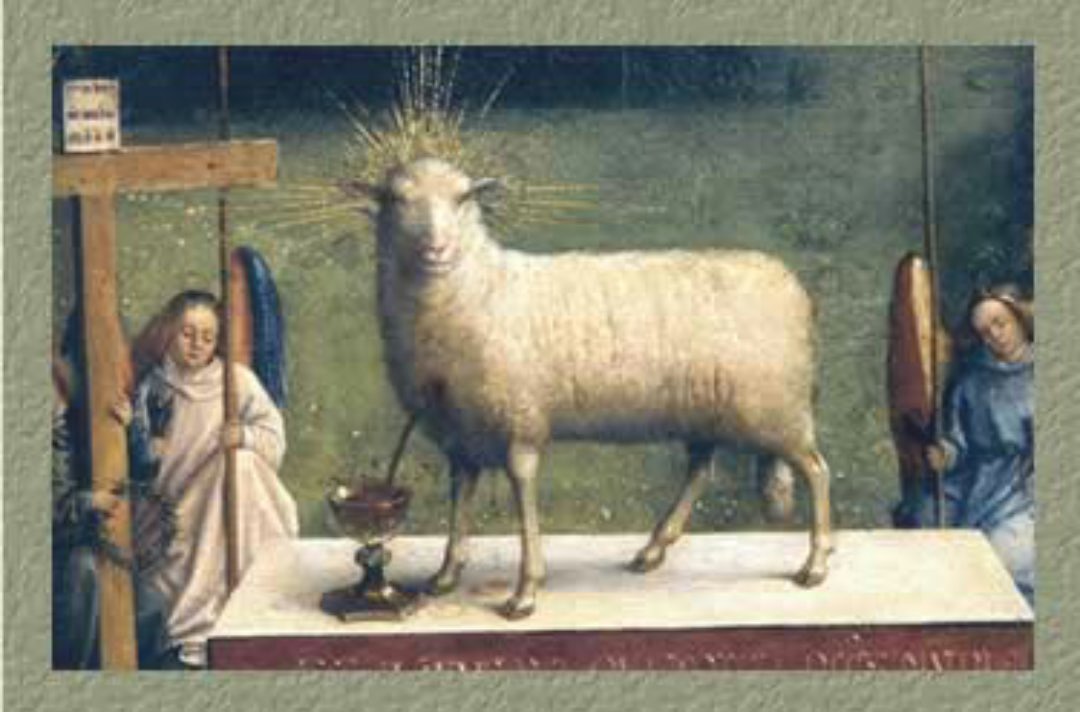
people to think that Christ was really an actual lamb, with fleece and hoofs. Sort
of like the lamb we find on today’s bulletin. It was only a description of
him. And, as such, should not be
represented in art and icons.
All of this, of course, hits home to
me this week because our Gospel reading for today deals with Christ as the Lamb
of God. And for some reason, this past
week, as I was meditating on our Gospel reading for today, the whole image of
Jesus as the Lamb of God really hit home to me in a new way.
In today’s Gospel reading we find John
the Baptist calling out not once but twice, identifying Jesus as the Lamb of
God. Now, we can kind of see where those bishops of Trullo are coming from. For
us, it’s a very nice image. A nice fluffy, sweet-natured lamb.
But…is that the right image we have of
Jesus? If God chose to be incarnate in the flesh, would God want to be looked
upon as a sweet, fluffy lamb? No, not
all. And that’s not what John is getting at when we calls out the way he does. Sweet and gentle is not what John saw when he
observed Jesus as the Lamb of God. For
John, what he observed when he looked at Jesus and saw the Lamb of God walking
past, was truly a thing that would most
vegans cringe:
he saw that sacrifice that was seen in
the Temple in Jerusalem.
There, the lamb was sacrificed—and
quite violently sacrificed—as a sin offering for the people. He saw before him not Jesus the man, but the sacrificial
Lamb, broken and bleeding.
To be fair, in our own images of the Lamb
of God, we don’t always have just a fluffy little lamb. In our images of the lamb, if you look at them
closely, we see the Lamb pierced. We see
blood pouring from the side of the Lamb. We see a sacrificed Lamb.
In our Sunday Mass, we sing the Agnes
Dei—the Lamb of God—after I have broken the bread. I am so happy that we do. This “fraction anthem” as we call it, carries
such meaning. In it we sing:
Lamb of God, who takes away the sins
of the world, have mercy on us
Lamb of God, who takes away the sins
of the world, have mercy on us.
Lamb of God, who takes away the sins
of the world, grant us peace.
Then you see me hold up the chalice
and that broken bread and you hear me
say,
“This is the Lamb of God. This is the
One who takes away the sins of the world. Happy are we who are called to this
supper.”
This shed blood. This broken body. This sacrifice. That is what we hold up.
I cannot tell you how many times I
have stood at this altar during that anthem and looked down at the broken bread
on that paten and looked into that cup and had a moment of real spiritual
clarity. So many times I have looked at the broken bread and the cup and
thought, this is Jesus. This is the Lamb of God.
For me, that moment of spiritual
clarity is very much like the moment John announces Jesus as the Lamb. For me, it might as well be the Baptist’s
voice in my ear, announcing to me that this is the One. And it should be for
all of us. The hesychasts of pre-revolutionary Russia would be proud with such
a revelation.
But more than just some mystical
experience is this concept of the Lamb being broken.
Why do we break the bread at the
Eucharist? Why do I, when I hold up that
broken bread with the chalice, say, “This is the Lamb of God. This is the One
who takes away the sins of the world…”?
Yes, we do it to symbolize the broken
body of the Lamb. The Lamb was broken. The Lamb was sacrificed. And it is importance
to recognize that. Trust me, we understand brokenness right now in our world,
in our society, and, no doubt, many of us know it in our lives. Brokenness is part of this imperfect world in
which we live. And it is hard to bear. When we gaze upon that broken bread,
when we gaze upon that broken lamb, we gaze upon our own brokenness as well. But
we gaze upon a God who understands our brokenness. A God who understands these
fractures and these pains each us bear within us and in this world in which we
live.
But it symbolizes something even more
practical. We break bread, so we can
share it. We don’t get the option of
just sitting around, wallowing in our brokenness. We don’t get to just close up
and rock back and forth in pain over the unfairness of this world and society
and our lives. We are called to go out
and do something about it. We break this
bread and then break it and then break it again until it becomes small pieces
that we must share with one another. By sharing our God who knows brokenness,
by sharing of our broken selves, we do something meaningful. We undo our brokenness. We become whole by
sharing our brokenness.
It means we take what we have eaten
here—this Lamb, this Christ, this God who knew pain and suffering and death—and
we share this Christ with others, through our love, through our actions of
love, through our acceptance of all people in love.
It is not enough that we simply recognize the broken Lamb. We must recognize the Lamb, broken for us, so
that we then can share the Lamb with others. And that is the purpose of our
lives as Christians.
Yes, we gather here and are Christians.
But we are also gathered here so we can
go out and share this Lamb that has been broken and given to us. And in sharing the Lamb, others too can share
the Lamb.
So, let us listen to the voice of the
Baptist proclaiming in our ears, “Behold the Lamb of God!” Let us hear that voice when I hold up the
Bread and the Chalice. Let us hear that
voice as we come forward to share that bread and drink from that chalice.
But let us be that voice when we leave here. Let us proclaim the Lamb of God as we share
Christ with others, in all that we do as Christians, in the differences we make
in this world around, in all the good we do and say in our lives. When we do that
we will find ourselves, as we heard in the beautiful collect from this morning,
“illuminated by [God’s] Word and Sacraments.” And being illuminated, we will “shine with the
radiance of Christ’s glory, that he may be known, worshipped and obeyed to the
ends of the earth.”
Sunday, January 8, 2017
1 Epiphany
The
Baptism of Our Lord
January 8,
2017
Isaiah
42.1-9; Matthew 3.13-17
+ Sometimes—oftentimes—when
one preaches week in, week in, the preacher maybe—sometimes—oftentimes—falls
into ruts. We preachers too are at the whim of our obsessions, whatever might be
right on the surface in our lives, or what have you.
So, of
course, on this Sunday—this Sunday of the Baptism of Our Lord, this Sunday in
which we officially end the Christmas season—yeah, you kinda know where I’m
going. You know it’s gonna be another of
one of those Fr. Jamie Baptism sermons. Because,
as you know, there are few things I like preaching about more than baptism.
It could
be worse, right?
Of course
I’m going to preach about baptism today. After all, we’re celebrating the Baptism of
Jesus today! And of course, how can we not talk about baptism? And ministry?
Because
this is what it’s all about for us as Christians. All ministry—the ministry we all do
together—stems from that transformative event of our Baptism. In
fact, to be baptized means, essentially, to be called to ministry. When we look at our spiritual lives and our
ministries in the “big picture,” we cannot do so without seeing that big
picture circling and being centered on the singular event of our baptism.
For those
of you who have visited the rectory you have no doubt seen my baptismal
certificate on my wall. It is there with
my ordination certificates. It is there
to remind me and to help me commemorate that incredible event in my life 47
years ago—this event that changed me and formed me as a Christian. And, this
gives me another opportunity to remind you, if you haven’t done so yet, to do a
bit of detective work and find the date of your baptism as well and to share it
with me or James so we can commemorate it and celebrate it. After all, everything we do as Christians
should come from the joy and amazing beauty of that simple event.
As you
all know, as you have heard me preach from here many, many times, probably to
the point you start rolling your eyes, Baptism, for me anyway, is not a sweet
little christening event for us as Christians. It is not a quaint little service of
dedication we do. For us Episcopalians, it a radical event in our lives as
Christians. It is the event from which everything we do and believe flows. It was the day we were welcomed as loved
children of God. And it was the day we began following Jesus.
And when
we look at the actual service of Baptism in the Book of Common Prayer, the
words of that service drive home to us how important that event is. For
example, after the Baptism, when the priest traces a cross on the newly
baptized person’s forehead, she or he says,
“You are
sealed by the Holy Spirit in Baptism and marked as Christ’s own forever.”
You have
heard me preach on those words many times before. And trust me, I will preach
them again and again. I will because they are probably the most important words
we are ever going to hear in our lives. That
is not just some nice little sentiment. Those
words convey that something transformational and amazing has happened in the
life of that person. This is essential
to our belief of what happens at baptism.
In
baptism, we are marked as Christ’s own. Forever.
It is a bond that can never be broken. We can try to break it as we please. We can struggle under that bond. We can squirm
and resist it. We can try to escape it. But the simple fact is this: we can’t. Forever is forever.
On this
Sunday on which we commemorate Jesus’ own baptism—on this Sunday in which we
remember the fact that Jesus led the way through those waters of baptism and
showed us a glimpse of all that happens in this singular event, we should
remember and think about what happened at own baptisms. Yes, we might not actually remember the actual
event. But the great thing about baptism
is that, our own individual baptismal event was, for the most part, just like
everyone else’s.
In those
waters, God spoke to us the words God spoke to Jesus in today’s Gospel reading.
In those waters, the words we heard in our reading from Isaiah were affirmed in
us as well.
Here is my servant, whom I uphold,
my chosen, in whom my soul delights;
Those
words are our words. Those words were spoken to us in those waters. In those waters, we were all made equal. In those waters, the same water washed all of
us—no matter who are. In those waters,
there are no class distinctions, no hatred, or discrimination or homophobia or
sexism or war or violence. Or walls. In
those waters, we are all equal to one another and we are all equally loved.
In a few
moments, we will stand and renew the vows we made at baptism. When we are done, I will sprinkle you with
water. The sprinkling of water, like all our signs and actions that we do in
this church, is not some strange practice a few of us High Church-minded people
do. That water that comes to us this
morning is a stark reminder of those waters we were washed in at Baptism—those
waters that made us who we are Christians, those waters in which we all stand
on equal ground, with no distinctions between us.
Here at
St. Stephen’s, all of our ministry—every time we seek to serve Christ and
further the Kingdom of God in our midst—is a continuation of the celebration of
baptism. Sometimes we lose sight of
that. Sometimes we forget what it is
that motivates us and charges us to do that wonderful work. Sometimes we forget
that our ministry as baptized people is a ministry to stand up and speak out
against injustice.
Our
ministry is to echo those words from Isaiah God spoke to us at the beginning of
our ministries:
I have put my spirit upon [you];
[you] will bring forth justice to the nations.
[You] will faithfully bring forth justice.
[You] will not grow faint or be crushed
until [you have] established justice in the earth;
[you] will bring forth justice to the nations.
[You] will faithfully bring forth justice.
[You] will not grow faint or be crushed
until [you have] established justice in the earth;
The water
of our baptism is a stark reminder to us of our call to the ministry of
justice. There is a reason the baptismal
font in the narthex—the place we actually baptize—is always uncovered and
always filled with fresh, blessed water. Again, this is not some quaint tradition that Fr. Jamie introduced here. This is a very valid and real reminder
that in that place, in those waters, we began to do the radical things we are
called to us as Christians. It is good
for us to take that water and bless ourselves, and with it to be renewed for
our call to justice. It is good for us
to be occasionally sprinkled with water as a reminder of what we must still do
in this world It is good to feel that
cold water on our fingers and on our foreheads and on our faces as a reminder
of our equality and our commitment to a God of love and justice. And, as
you have heard me say many, many times, it is good to remember the date of our
baptism and to celebrate that day, just as we would a birthday or a wedding
anniversary.
Today, on
this first Sunday in Epiphany, we start out on the right note. We start out celebrating. We start our
commemorating the baptism of Jesus in the river Jordan. And by doing so, we commemorate our own
baptism as well.
In our
collect today, we prayed to God to “Grant that all who are baptized into
[Jesus’] Name maybe keep the covenant that they have made, and boldly confess
him as Lord and Saviour.”
That
should be our prayer as well today and always. We pray that we may keep this Baptismal
covenant in which we seek to follow Jesus and serve all people equally and
fully in his name, no matter who they are. And we pray that we may boldly live out our covenant
by all that we do as Christians in seeking out and helping others in love and
compassion and justice.
May we
always celebrate that wonderful baptismal event in our lives. And may we each strive to live out that
baptism in our radical ministry of love and service of God and of one another. Amen.
Sunday, January 1, 2017
The Holy Name of Jesus
Holy Name
January 1, 2016
Numbers
6.22-27, Psalm 8, Galatians 4.4-7 and Luke 2.15-21
+
Happy New Year. I always sort of revel in the New Year. I really kind of like
this time. I love getting up early on New Year’s Day and driving around town. It
is so quiet and so serene.
This
getting up early on New Year’s Day is a new tradition for me, especially ever
since I became a teetotaler a few years ago. It’s nice waking up on New Year’s
Day and not having a hangover, or, as my mother calls it, the “bottle flu.” There
is always something so hopeful and wonderful about New Year’s Day.
But…I
am going to share a story of a time when it wasn’t so wonderful and hopeful in
my life. Fifteen years ago, as the new year of 2002 began, I faced a bleak new
year. I had just been laid off from a job I really enjoyed because, surprise of
surprises, I had some issues with my superiors. If you thought I was rebellious
now, you should’ve seen me back in 2001!
It
was an unpleasant situation, and two days after Christmas, they informed me
that they were letting me go due to a “financial shortfall.” I knew
the real reason., We all did.
But
I limped toward the end of that year beaten down a bit. I was still three years
away from being ordained a priest, and the past year had been a particularly
difficult one for me in ministry. I was still transitioning from my pre-ministry
life to the stark realities of what real ministry was like. And, let’s just
say, it was hard. And it wasn’t always fun.
As
that New Year dawned, I, for the first time in several years, had very serious
doubts about whether I should be ordained or not. And I
was, to put it bluntly, struggling. I was definitely praying for an answer, but
no clear answer came.
In
fact, rather than a clear answer telling me I should definitely go forward, the
new year brought me a bigger devastation than losing my job. In February of
2002, I was diagnosed with cancer. And I
spent most of the rest of that year getting better.
It’s
not the most pleasant story for us to hear on this New Year’s Eve. But…actually
it kind of is. The answers I received to the prayers I was praying on that
bleak New Year’s Day in 2002 were answered. They were just not answered in the
ways I expected, or even wanted. My zeal for being a priest was renewed. I was healed.
I got well. I pushed forward. And look! I endured.
And
when anyone asked me then, or even now, what got me through, I say:
The
love of my parents, the support of my friends and the Holy Name of Jesus.
In
the midst of the stress and turmoil of it all, in those moments, when I
couldn’t form a tangible prayer in my head, the prayer I prayed most was simply
the Name of Jesus. If any of you have ever been anointed by me in the hospital
or at any other time, you will have invariably heard me repeat a wonderful
passage that we find in the Book of Common Prayer. It goes,
The Almighty Lord, who is a strong tower to all who
put their trust in him, to whom all things in heaven, on earth, and under the
earth bow and obey: Be now and evermore your defense, and make you know and
feel that the only Name under heaven given for health and salvation is the Name
of our Lord Jesus Christ.
That
passage spoke loudly to me back in 2002, especially when I was so sick. And you
know what? It speaks loudly to us this morning as we begin this year of 2017.
Today,
we celebrated the Feast of the Holy Name of Jesus. This
feast used to be known at the Circumcision of Our Lord. We have kept the feast, but we’ve changed the
name, probably for good reason. On the
eighth day following Jesus’ birth, he, like all Jewish males born in his time,
was brought to the temple, circumcised and named.
His
name, Jesus or Joshua, Yeshua in
Hebrew, was a common name in his day. There
are two differing translation of the name: one is “God with us.” The other is “God saves,” or more specifically
“God saves us from our sins.”
Today
is an important feast. It’s a VERY important feast. Because, that Name is
important to us. It’s important to those of who have been healed by it. It’s
important for those of us who have found that it is, at times, the only prayer
we can pray.
Today’s
feast also reminds us that we do truly have an intimate relationship with God. God
is no longer a nameless, distant deity. God
has a name. The God who came to us in
Jesus has a name.
Names,
after all, are important. Our names are
important to us. They define us. We
have been trained to respond when we hear our name called. We, in effect, are our names. Our names and
ourselves are bound inexorably together.
Our name is truly who we are.
The
same can be said of God. In the Old
Testament God reveals the Divine Name as Yahweh. Yahweh is such a sacred and holy word to Jewish
people that it cannot even be repeated. In
a sense, the name Yahweh becomes so intertwined with Who God is that is
becomes, for the Jews, almost like God. And I agree completely.
It
is the Name God revealed to Aaron. God
said,
“they
shall put my name—Yahweh—on them and I will bless them.”
The
message here to all of us is that to have a truly meaningful
relationship with anyone—to truly know them—we need to know them by their name.
So,
too, is this same idea used when we think about our own relationship with God
and, in turn, God’s relationship with us. God knows us by name and we know God by name. This
is important. God is not simply some
distant Being we vaguely comprehend. God
is close. God is here, with us. God knows us and we know God. We
know each other by name.
This
is why the name of Jesus is important to us.
That is why we give the Name a
certain level of respect. Like the Name that was revealed to Aaron, so has the
Name of our God been revealed to us. And like the name Yahweh to the Jews, the Name
of Jesus is holy and sacred to us Christians.
Certainly
even for us, the Name is a vital and important part of what we believe as
Christians. The collect for
today recalls that the name of Jesus is the “sign of our salvation.”
Now, I don’t see that as a sweet, overly sentimental notion. I see it as a very important part of who we
are as Christians.
As most of you know, I try very hard to take the Name of Jesus
very seriously. Coming from a more High Church background, you’ll notice
during our liturgy on Sunday or Wednesday night, I bow my head every time the
Name of Jesus is mentioned. Again, I don’t see that
as an overly pious action. I see it as a sign of respect for Jesus
at a time when his Name is widely abused and misused.
We’ve
all done it. We’ve all sworn, using the
Name in a disrespectful way. I’ve done
it. We have not given the rightful
respect to God’s name in our lives, even when we know full well that a name is
more than just a name.
A
Name is, in a sense, one’s very essence.
Certainly in the case of Jesus
case, it is. Jesus is “God with us.” Jesus is “God saving us.” By this very name we have a special
relationship with this God who has come among us. We
belong to this God whose name we know. God,
in Jesus, has come to all of us. God in
Jesus knows each of us by name. We are
special to our God. We are, each of us, deeply loved and cared for by our God.
Certainly
those of us who are Christian know this in a unique way. When we were baptized,
we, like Jesus eight days after his birth, were named. At our baptism, we were
signed as Christ’s own forever. We were claimed by God by name. By Baptism, our
own names became holy names. By Baptism, God came to know us by name and
because of that, our names are sanctified. We bear in us our own holy name
before God.
So
today—this day we celebrate not only God’s holy name but our own as well—and in
the days to come, take to heart the fact that God’s name is holy and sacred. Be
mindful of the words you use and be mindful of that name of Jesus in your life.
But
also be mindful of your own holy name. When you hear your own name, remember that it
is the name God knows you by and, as a result, it is truly holy. In sense our own names can be translated as “God
with us.” When we hear our names, let us
hear “God saves us.” And let us be reminded that God knows us better than
anyone else—even our own selves. Claim the holiness of your name and know that
God in Jesus is calling you to your own fullness of life by name. Amen.
Subscribe to:
Posts (Atom)
19 Pentecost/St Francis of Assisi
October 4, 2026 + Today, of course is the feast of St. Francis of Assisi, one of the most beloved and revered saints in the Church. ...
-
October 1, 2026 Dear St. Stephen’s-- After much prayer, discernment, and conversation with our Wardens, Vestry, parish clergy, B...
-
April 2, 2008 The Chapel of the Resurrection Today is the feast day of one of my favorite saints in the Episcopal Church, James Lloyd Breck....
-
The Baptism of Our Lord January 11, 2026 Isaiah 42.1-9; Matthew 3.13-17 +Well, this past week was one of those weeks in wh...